How Is the Rolf Method of Structural Integration Different Than Massage?
A Transformational Approach to Long-Lasting Change
Most people find their way to my office because something in their body hurts, feels stuck, or keeps getting in the way of how they want to move. And just as often, they arrive expecting a massage—something soothing, something that targets the painful area, something that helps for a day or two before the familiar tension returns.
But the work I do is a very different conversation with the body.
As a practitioner trained at the New School of Structural Integration—a lineage rooted in Hellerwork—and someone who has woven osteopathic, visceral, and craniosacral methods into my sessions, I approach the body through a wider lens. Structural Integration (SI) isn’t simply about easing tension; it’s about reorganizing the body’s architecture so it can move with more ease, adaptability, and integrity. The best way I implement this is through a series of sessions known as The 10 Series.
And that difference is exactly why SI can create the kind of long-lasting change that massage often cannot- Because instead of focusing on soothing muscles, SI reorganizes the entire body.
Who Structural Integration Helps Most
While almost anyone can benefit from Structural Integration, I find it especially transformative for people dealing with:
chronic pain patterns
limited mobility
lingering injuries that never fully resolved
sciatica
frozen shoulder
knee problems
ankle injuries
and complex compensations that don’t respond to standard treatment
These issues often have roots that lie beyond the site of pain—and SI excels at unraveling those underlying patterns.
What makes Structural Integration Unique: Working with the Fascial matrix
When I explain Structural Integration to clients, I often describe it as work that uses the body’s fascia—the connective tissue that wraps everything—to systematically create space for healthier movement. Fascia is the body’s internal webbing. When it becomes restricted or pulled off balance, the whole system compensates. SI’s job is to restore harmony to that web, so the body can organize itself around a new, more supported way of being.
Because fascia connects everything, SI sessions are inherently global. Instead of chasing symptoms, we change the patterns underneath them.
Why SI Is Not “Just a Different Style of Massage”
Massage is incredibly valuable, but its primary intention is comfort and symptom relief. It focuses on muscle tissue, uses kneading techniques, and often zeroes in on the area that hurts.
Structural Integration takes a different path:
It looks at the whole body, not the pain site.
It works slowly and intentionally with fascia, joints, and ligaments, not just muscles.
Sessions are interactive, with movement, feedback, and awareness-building.
The goal is long-term change, not temporary relief.
This surprises many new clients. Clients used to deep tissue or sports massage will expect me to spend a full hour on the painful shoulder or tight low back. Instead, they discover that their shoulder pain might be rooted in how their ribs rotate, or their foot pressure, or how the pelvis stabilizes their weight. And that deeper understanding becomes a doorway to real change.
What Clients Usually Get Wrong About SI
I hear two misconceptions all the time:
“You’re going to work right where it hurts.” But the body is a network. Where it hurts is rarely where the pattern started.
“I’m just going to lie here and relax.” In SI, the client is an active participant—moving, sensing, providing feedback. We’re building awareness, not just comfort.
This engagement is a big part of why the work has such a lasting impact.
Case Studies That Show the Difference
1. The Weight Lifter With Chronic Shoulder Pain
He came in frustrated—strong, capable, and diligent about his training, yet stuck in a cycle: massage → temporary relief → pain returns.
Through the 10-Series, we changed the way he used his shoulders during lifts. We addressed rib rotation, shoulder girdle support, breathing mechanics, and the balance between front-body and back-body engagement.
Instead of a typical sports massage session which focuses on recovery from muscle soreness, we gave his opened up new movement patterns through his ribcage and shoulder that supports more efficient movement.
By the end, his lifts felt smoother, his shoulders more responsive, and the chronic irritation simply wasn’t returning.
2. The Client Recovering From an Ankle Sprain
She’d done the rehab. She’d rested. She’d received a massage. But months later, something still wasn’t right.
In just two SI sessions, we reorganized how her ankle, foot, and hip were communicating with each other. The pain dissolved, but equally important, she regained a sense of confidence—she could trust her body again. Small daily movements suddenly felt adaptable, fluid, and natural.
3. Twenty Years of Plantar Fasciitis and Sciatic Pain—Gone in One Session
This client had lived with pain since he was 18. Decades of cortisone injections, stretching, strengthening, bracing—nothing made a meaningful dent.
After his first session, he stood up and looked at me with wide, disbelieving eyes. For the first time in two decades, he felt no pain.
What shifted wasn’t just tissue—it was his entire relationship with gravity and support. His body finally had space to function without the constant grip of compensation.
These are the kinds of changes SI is designed to create.
The Part Clients Love Most about SI
What consistently resonates with people is the moment they realize that the changes on the table aren’t isolated. They start noticing:
that walking feels easier
that their breath moves differently
that their shoulder no longer hikes during stressful moments
that they can stand, lift, or sit without bracing
that their body feels more organized, more like home
Awareness is what makes Structural Integration stick. My goal as a practitioner is to equip my clients with a better understanding of how their body responds to stress, and form new patterns to regulate the ups and downs life throws at them without the chronic pain.
Structural Integration: A Different Path Toward Healing
Massage brings ease. Structural Integration brings transformation.
One soothes the muscles. The other reorganizes the entire body.
If you’ve been stuck in a loop of pain, tension, or recurring injury, and you’re ready for a deeper, more whole-body approach, SI may be the missing piece—the shift that helps your structure find its way back to balance, ease, and possibility.
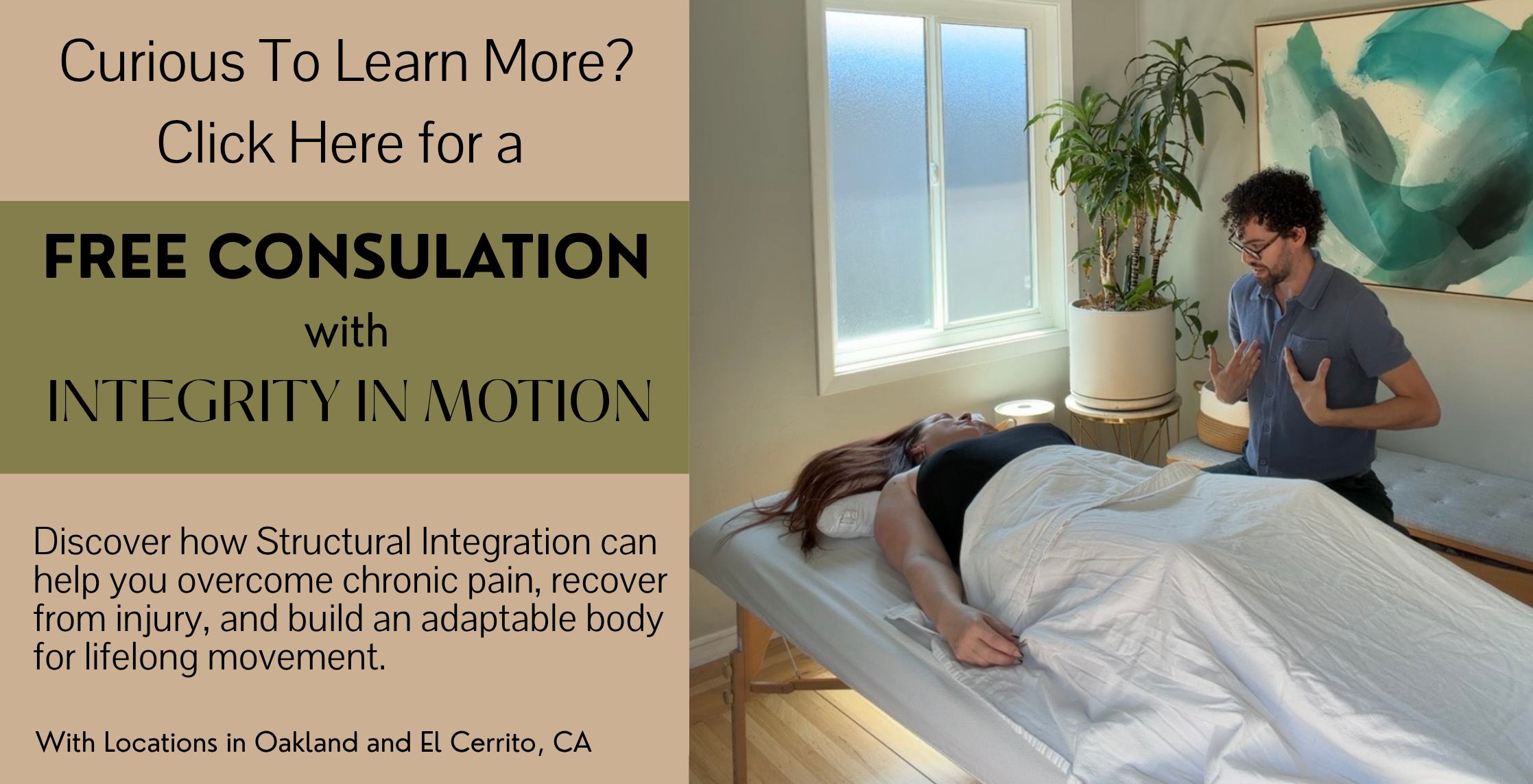
If you’re curious about how Structural Integration can help you, schedule your free consultation where we can discuss your specific needs.